Wednesday, 15 June 2016

Domaine de la Pinte Savagnin 2006

Our focus here will be on Domaine de la Pinte Savagnin 2006, but before describing the wine we will discuss the Jura in general and various wine making factors that influence the final product. First, a brief summary of the method used in making this wine...

Made from 50 year old vines, the must is allowed to settle for 18-24 hours after crushing before racking off the wine (also known using the French term debourbage, this reduces the need for filtration or fining), then undergoing malolactic fermentation in temperature controlled cement vats using indigenous yeast. The wine then spends 18 months on the lees and five years in large old French oak barrels, allowing only a restrained level of oxidisation.

The Jura

In eastern France's Franche-Comté, the Jura is a small region scattered amongst woodland and meadow in the foothills between Burgundy and Switzerland, 50 minutes from Burgundy's historic wine capital Beaune. Between Burgundy and the Jura is la Bresse, flat land lying either side of the river Saône. The vines start when the ground begins to rise towards large limestone plateau in the east.

The Jura
The Jura vignoble (vinyards) were decimated by a combination of mildew and phylloxera at the end of the 19th century, the first world war, then the railways which opened the Languedoc as an alternative source of wine to the city dwellers of northern France. Less than 1000 hectares of vines remained by the 1960's, which had been 10 times the size before phylloxera, and even today there are less than 2000 hectares, making it one of the smallest wine regions in France.

The Jura known for unusual grape varieties vinified in distinctive styles, and it's wines have become increasingly fashionable, not least because of their often organic and natural credentials. It is a land of lush green farmland, heavily influenced by the food, soils and weather of Burgundy to the west, and is home to fantastic selection of cheeses.

Soils and Climate

Like Burgundy, Jurassic limestone soils overlayed with clay are characteristic of Jura, but there is enormous variation in aspect, elevation and soil types, suiting different grape varieties - the Jura's signature Savagnin grape excels on marl soils but does not do so well on limestone.

Marl soils contain a crumbly mixture of clay sediments, mixed with calcium and magnesium carbonates, and fossilised sea shells, collected at the bottom of the ocean during the Jurassic and Cretaceous periods. Marl soils are rich in mineral and organic content, although this is not easily absorbed by the vine. They are cold soils giving slow regular growth, holding back ripening, and giving wines with high acidity. The different colour marl soils result from varying organic and mineral content (including blue, white, black and red).

Limestone is a sedimentary rock dating from same period as marl, predominantly composed of fossilised sea shells. Limestone itself is hard and not easily penetrated by plant roots except through cracks. Soils formed from on broken up limestone are rich in calcium carbonate, easily absorbed by plants. These soils have good drainage capabilities, and unlike clay do not stick together when it rains, and reheat quickly in the spring. Wines from limestone soils are typically structured and mineral, but can be very dry on the palate.

The Jura has a continental climate, with long cold winters and hot summers, but in its jumbled terrain there is more rain and the winters can be much more severe than Burgundy. Continentality is the temperature difference between the hottest and coldest months. Continental climates have a wide temperature range, and are typical of the interior of large continents. Maritime climates have a narrow temperature range, and usually occur near oceans or other large water bodies, which provide a moderating influence. Continental climates are characterised by short summers, then a large rapid temperature drop in the autumn. They usually have little rainfall and wide diurnal temperature variation (difference between day and night) during the growing season.

As in the Côte-d'Or, the best vineyards slope, sometimes steeply, south and south-east, maximising exposure to sunlight and heat. This helps ripen the grapes, with steep slopes increasing the affect further. The vines are trained high to avoid spring frosts, and the harvest is late and can often extend into November.

Grape Varieties

Five grape varieties are widely planted, including the two main Burgundy grapes. Some Pinot Noir is grown, traditionally blended but now more often single varietal, making wines of pale colour that are fragrant and earthy.

Chardonnay is well suited to the heavy clay soils and is widely planted, increasingly vinified in the non oxidative Burgundian style called floral by some locals. Acidity is higher than in Burgundy, consequently the wine is generally oak aged for longer, at its best giving rich and complex wines. Chardonnay can also make a Vin Jaune like wine when aged under flor, and is also used as the base for the traditional method sparkling wine Crémant du Jura.

The Jura is best known for its three distinctive native varieties. Poulsard (also known as Ploussard, especially in village of Pupillin) is a large oval black grape variety which has very thin skins with little colour pigment and low in tannin. Poulsard is often blended with Pinot Noir as it can have little colour even when macerated for several weeks, making light bodied red wines that are fragrant and delicate, and can be good served slightly chilled.

Trousseau (also known as Bastardo, a variety used in making port) is an ancient variety that buds late avoiding the spring frosts, producing irregular yields. Trousseau produces deeper but still pale coloured wine, full flavoured and bodied, often gamey and earthy, with hints of strawberry.

The Jura's most famous variety Savagnin Blanc (also known as Naturé or Fromentin) is identical to Traminer from the Alto Adige, therefore related to its aromatic, pink-skinned variant, Gewürztraminer. Savagnin is well adapted to the climate, ripening slowly, with picking as late as December in some years. However it is difficult to grow, producing irregular yields of small pale berries, sometimes almost nothing. Savagnin produces long lived, full bodied dry white wines, often deliberately exposed to oxygen during ageing. Some non oxidative wines are made, either single varietal or blended with Chardonnay, producing fresh, full bodied wines, with a hint of spice and bone dry.

Savagnin is used to produce the famous Vin Jaune 'yellow wine' of the Jura. Savagnin grapes are picked late, usually late October but often November, when the grapes are as ripe as possible, with potential alcohol between 13% and 15%. The grapes are fermented slowly, then transferred to age in 228 litre old oak Burgundy barrels, which are never topped up. The wine becomes partially protected from oxidation by thin veil of yeast, locally called 'voile', very similar to the flor on sherry. To qualify as Vin Jaune, the wine must be aged in the barrel for at least six years and three months, after which time only about 62% of the wine remains after evaporation. The wine bottled in the unusual stubby clavelin bottle holding 62cl, supposedly the volume left of an original litre put into barrel.

Malolactic Fermentation

Malolactic fermentation (commonly referred to as MLF or malo) is the conversion of sharper (tart, unripe apple) malic acid to softer (milk like) lactic acid through the action of naturally occurring or added bacteria (Oenococcus oeni and various species of Lactobactillus and Pediococcus). Carbon dioxide is also produced during this process, hence the term fermentation. The reduction in acidity is because malic acid has two acid radicals, whereas lactic acid only has one.

Primary fruit aromas are lost during malolactic fermentation, but by-products such as diacetyl are formed, which gives the wine a buttery richness (but in excess can give strong caramel and rancid butter character). Malolactic fermentation is considered to give the wine a rounder, fuller mouthfeel.

Malolactic fermentation usually takes place shortly after the end of primary fermentation (when grape sugar is converted to alcohol by yeast). It is almost always used in red wine making, but only for some white wines (generally lighter bodied, fruit driven wines with crisp acidity do not benefit). Winemakers can can alter various factors to encourage or discourage malolactic fermentation from occurring. Leaving the wine on the yeast lees after primary fermentation, as early racking clarification reduces nutrient and bacterial levels. Using low levels of sulphur dioxide before fermentation, and not adding any sulphur dioxide post fermentation until malolactic fermentation is complete, as levels greater than 25 mg/l will inhibit bacterial growth. Maintaining wine temperature between 17-20°C and increasing the pH to above 3.1. Adding freeze dried MLF bacteria or lees from tank already undergoing MLF (during or after alcoholic fermentation) will also kick start the process. Malolactic fermentation should never be allowed to occur in bottle, as the wine will appear to still be fermenting (carbon dioxide being produced), this can be prevented by sterile filtration at bottling.

Oxidative versus Reductive Winemaking

Wines can be made in an oxidative or reductive style. Because yeasts ferment wine mostly under anaerobic (without oxygen) conditions they generate lots of smelly volatile sulphur compounds including hydrogen sulphide and mercaptans which would otherwise be neutralised by oxygen. If wines were made and bottled without any contact with oxygen these compounds would remain in the wine and be noticeable once the bottle was opened.

Therefore wines are generally given some exposure to oxygen during fermentation and élevage (French term for progression of wine between fermentation and bottling), for example in open top fermentors or during racking. Conversely by using stainless steel tanks and inert gasses, the level of exposure to oxygen can be greatly decreased. Most wine making lies somewhere on between, neither totally totally reductive or oxdative, avoiding the risks of either extreme, preserving the fruit character whilst adding complexity.

Generally modern making tends towards the reductive wine making style, which emphasises primary fruit flavours and aromas, typically giving wines fresher and paler in colour. However in overtly reduced wines, volatile sulphur compounds can develop, giving the wine a burnt matchstick, sewage, or rotten egg aroma. Sometimes these characteristics will diminish with decanting or vigorous swirling. Towards the oxidative end of the spectrum, the risk of oxidation is increased, where wine has had too much uncontrolled exposure to oxygen, turning the wine brown and flat, with faded fruit flavours and taking on a nutty, bruised apple character.

Oxidative wine making is a style still practiced in many Jura wines, along with Sherry, Madeira, and others. Wines made in this style are generally more stable, being less vulnerable to the negative effects of later oxygen exposure. Oxidative versus reductive wine making is also an important factor in determining Champagne style.

Domaine de la Pinte

Domaine de la Pinte was bought by Arbois native Roger Martin in 1953 and replanted with 20 hectares of mostly Savagnin vines, with the first harvest was in 1959. The vineyards now cover 34 hectares in the Arbois and Arbois-Pupillin appellations (17 hectares of Savagnin), situated on a band of blue marl running between Arbois and Château Chalon at an altitude of 400 metres. The estate has been organically farmed since 1999 and biodynamically since 2009, when viticulturist Bruno Ciofi was hired to take over winemaking. The wines typically have fresh acidity and mineral characteristics, and mostly avoid the extremes associated with the region.

Domaine de la Pinte Arbois Savagnin 2006

Domaine de la Pinte Savagnin
The wine is a rich, golden, honeyed amber colour in the glass.

Pronounced on the nose, distinctively oxidative, nutty and sherry like, with beeswax polished hard wood furniture and worn belt leather. There's wildflower heather honey, sweet vanilla spice, nutmeg and cinamon. Sour apple, ripe apricot stone fruit, and brighter yellow apple and grapey notes give the wine some freshness, and there's a yeasty, biscuity character.

A creamy, leesy, full bodied mouth feel on the palate, umptuous and glossy, but still dry, with eye watering high acidity and definite salinity. Feels warm, with medium plus alcohol and pronounced intensity. Spicy white pepper and nutmeg, with green fruit again on palate, granny smith apple and pear. More citrus than on the nose, bitter dry orange peel.

Outstanding and distinctive, showing definite age. However there's still plenty of acidity with potential for more tertiary character and further integration, interesting to try again and see how this has developed in a few years time.

Somewhere between a Fino sherry and aged white Rioja!


Saturday, 4 June 2016

Wines from Sepp & Maria Muster

Maria & Sepp Muster are winemakers in Südsteiermark, southern Styria, near Austria's Slovenian border. They are committed to following strict biodynamic principles (certified biodynamic by Demeter since 2003), including practices such as the potentising and spreading of plant, mineral and animal substances, and also following the patterns of the planetary constellations. With these methods they aim to maximise the vitality of the soil and vines, consequently impacting upon the quality of the resulting wines, and make the use of chemical herbicides and fertilisers unnecessary.

Austria
The vineyards are steeply sloped and on rocky lime soils composed of clay silt known as Opok, at an altitude of around 450 metres, and are worked mostly by hand. Sgaminegg, the best vineyard of the estate, has southern facing slopes of pure Opok soil (apparently the word Sgaminegg is a Slavic word meaning 'from stone'). Sgaminegg is sparsely planted with old Sauvignon Blanc and Morillon (traditionally used in Steiermark as a synonym for Chardonnay) vines, in the top third of the vineyard slopes. This has very poor soils, yielding fewer clusters of small berried grapes, all of which are hand selected and picked.

Vines generally grow best in poor soils where they must work hard to find nutrients and water. This lack of water stresses the vine and forces it to prioritise the development of the berries rather than the leaves and canopies, because the berries (which contain seeds) are the vine's mechanism for propagating. Restricted water and nutrition also result in lower yields of smaller berries which have more concentrated flavours. In poor soils the roots must work harder to find nutrients, increasing the mass and depth of roots, meaning more nutrients ultimately reach the vine, and also making the vine less susceptible to changing weather patterns.

Steeply sloped vineyards aid drainage and are typically low in nutrients due to years of erosion, consequently the soil will be poorest higher on the slope. In the northern hemisphere, vineyards in cooler regions benefit from a southerly aspect, which has the greatest exposure to heat and sunlight. This helps ripen the grapes, with steep slopes increasing the affect further.

Stony soils are generally well drained with limited water holding capacity, and not too fertile. They help moderate diurnal temperature variation (temperature variation over the course of a single day), by absorbing heat during sunshine, and radiating it during the night and cloudier periods.

They have a weak continental climate, with warm summers and mildly cold winters, influenced by the nearby Koralpe high mountain plateau, which gives cool nights and winds. Continental climates are characterised by short summers, then a large rapid temperature drop in the autumn. A northern continental climate typically has severe winters (no moderating ocean influence like Bordeaux) and hotter summers (but here these are moderated by the cooling effect of the mountain plateau). The winds of the Koralpe have particularly significant influence on the wines from the Sgaminegg vineyard.

The vineyards are managed using the traditional single wire trellising on 1.8 metre chestnut posts, with the one year old canes hanging down from the wire, giving a slightly wild appearance. Winemaking is as natural as possible, with spontaneous fermentation often in oak barrels and casks, and long barrel ageing for up to two years. Wines are bottled without fining or filtration, with no or minimal use of sulphur dioxide. The grapes are destemmed and gently crushed over 4 hours, with the concentrated juice fermenting and maturing in small oak barrels, then maturing for a further 12 months in large casks.

They believe all these factors result in warm and complex wines, which have distinct varietal aroma character and potential to develop over a period of years. The wines from the Sgaminegg vineyard have a fuller structure, with more extract/density, and a pronounced mineral character.

Opok
And so to the important bit...

Sepp & Maria Muster Opok 2013

A blend of Welschriesling, Sauvignon Blanc, Morillon and Muskateller.

Pale lemon colour.

Pronounced nose giving distinctive impressions of cider apple vinegar, sightly soured apple/orange juice, and tropical pineapple. Funky, farmyardy, slightly cabbagey, with baked apple, straw and hay. Some yeasty Fino notes.

Dry, medium to high acidity, medium alcohol, medium body, medium plus intensity. More citrus fruit on the palate (orange zest/pith), with a distinctly mineral/stony character and some saline tang. Medium plus finish.

Excellent, quite distinctive, creamy mouth feel, but with some mineral elements.
(05/16)

Sepp & Maria Muster Sgaminegg 2008

Sgaminegg
A blend of Sauvignon Blanc and Morillon (Chardonnay)

A pale lemon colour in the glass, distinctly golden and bright. Glossy, oily and glass coating.
Wow - a pronounced and complex nose, savoury and sophisticated, with definite signs of development. There's a distinctly vegetal, slightly cabbagey, aged Sauvignon character, but with some fresher asparagus and white floral wild garlic flowers. The wine is rich and nutty, with brazil nut, polished hard wood, tanned greasy leather. For me there's quite a musty sense, like dusty, cobwebby cupboards, with a cereal, wet wool character. Still some tropical and stone fruit (apricot, pineapple) remaining.

Dry, with medium to high acidity, medium plus alcohol (feels fairly spicy and warm), pronounced intensity. The vegetal cabbagey character distinctive again on the palate, along with some saline, slightly salty seaweed. There's more citrus than on the nose, tart, mouth puckering lemon juice, and some green apple. Savoury black peppercorn spice, especially on the long finish.

Outstanding, complex and multi layered (add own superlatives).
Developing, but still with plenty more potential to develop (plenty of acidity and vibrancy remains).
I think this is is a superb wine which I love, however it does have fair amount of tertiary character, some of which may not be the everyone's taste.
(05/16)

Sepp & Maria Muster also produce a wine Erde, using same varieties but fermented on the skins and stems for 6 to 12 months, which I'm looking forward to an opportunity to try.

Friday, 13 July 2012

Sam & Wil Dolomites 2012

Passo Giau

5 hours delay gets a little boring, and getting your dinner for free doesn’t really compensate for losing the best weather day of the week. This was the first time in the Dolomites for Wil and me, and I’d like to say we were met by stunning mountain scenery, but our 3am arrival in Cortina didn’t provide the best views. Nevermind, a good lie in, we can still make the most of the day with some sport cragging. That’s if the Polizia hadn’t shut both lower and upper mountain passes for the lycra clad brigade. Eventually we make it through as the stragglers ride past. Go-cart handling in our Fiat 500 rental car is fun, its rev-counter working hard to drag a week’s worth of climbing gear and clean underpants up the steep mountain passes. Reaching the high point of Passo Giau, even relatively uncelebrated peaks look inspiring. A small stout tower nearby dominates over the viewpoint, coach tours and bikers gazing in awe while slurping warm lager. The same thought comes to us both at once, the rock looks great and the guidebook shows a 8 pitch IV running up the Gusela’s south west wall, with only only a twenty minute walk-in.

Wil on Via Dellago

Via Dellago is a great surprise that neither of us expect, almost having written off the day to hold-ups. A few steady but interesting pitches on decent rock then we get some practice scrambling together over the straightforward upper pitches. One route down, we negotiate the giant rock crevasse onto the summit proper, then after a few victory shots begin the trudge back down the car. Tourists now retreated, we back on the road, stopping off for celebratory pizza and beer, the mood somewhat sobered by an Italian football defeat. Canezi at last, the campsite gate’s been locked up for the night, but we get the tent up then into bed, checking in will wait until the morning.

Keeping the customers happy

Monday, a late start and the forecast’s not looking so promising so we decide on an easy day doing a few single sport pitches at the base of the Piz Ciavazes. Frustratingly the weather turns out better than expected, but nevermind, the forecast is to stay fine for the next few days.

We’d decided not to take the multifuel stove, less hassle just using gas. Typically gas cylinders prove hard to track down, not that a staple diet of pizza is too much hardship. Nevertheless, lumpy milk power tea tastes amazing when finally we chance upon an outdoor shop selling the necessary article, which somehow we’d missed earlier in the week.


Wil on Messner route

Tuesday, the Messner route on North Wall of the Second Sella Tower, at last a recognisable route. Mostly solid, the coarse dolomitic limestone gives good friction and sharp pockets. Grade VI makes the climbing a little more challenging, continuously absorbing moves on great rock. We make good time again and move together for a few easier pitches, this time taking a few more coils so avoiding horrible rope drag. Drizzle starts as we scramble down the descent, but turns back to glorious sunshine later in the evening, so we put decide vary our diet and cook sausage and pasta for tea.


Wil on Tissi route

Now with gas, Pizza has to be earnt, so Wednesday we make a prompt start and plan for two routes. First the Tissi route on the First Sella Tower, straight into brutal cracks and chimneying, but eases after that. A good route with enjoyable climbing, though of lesser quality and not so consistent. This time we make several abseils down, we’re both tiring now after 6 pitches in the hot sticky weather, but our promise of pizza after two routes gives the incentive needed, so we compromise and decide on the Micheluzzi route on the Piz Ciavazes, looks a much less intimidating prospect than our intended objective, the Zeni Corner.

Start of the day

Argh, where’s my belay plate, must have left it at the Sella Towers, it was hot after abseiling. Nevermind, suppose an Italian hitch seems appropriate given the country. Brilliant rock and sustained interest give great value climbing for the first two pitches, before clouds draw in and the first spots of drizzle start to fall. Deliberation decides it’s best to back off now before descent gets difficult after the traverse pitches, think we can allow ourselves pizza, we started both routes after all. A run back up to the Sella Towers to retrieve one belay plate makes sure of the pizza.

Sam on Micheluzzi route


Thursday, we decide to give the Micheluzzi another go, swapping the first pitches, then going off route on the third. A scary bold traverse gets us back on route, and almost onto the classic traverse, before rain threatens and dramatic rolls of thunder make the decision to turn around easy. Half an hour later the storm quickly clears up and we’re in brilliant sunshine, so make the most of it and head out again for some sunny sport cragging. A few routes later and our decision to back off earlier proves correct, heavy rain and exciting flashes of lightning send us sheltering under the steep routes and glad we’re not nearing the top with no easy escape! We’re both shattered anyway, so glad of the chance for some rest.

Two days to go, forecast for Friday decidedly pessimistic, but Saturday looks good all day, this is our chance to tick a big alpine route. I’m apprehensive, not sure I’m really up to this, telling myself another classic route on the Sella Towers would still make a great day, but know I’d go home feeling disappointed. Friday morning the rain is beating on the tent and massive crashes of thunder don’t help ease the anxiety. After lunchtime coffee and pastry things are looking much better, so soggy tent stuffed in a bag and packed in the car, we make our way to Malga Ciapela and begin the trudge up to Refuge Falier, psyched for the Marmolada tomorrow.


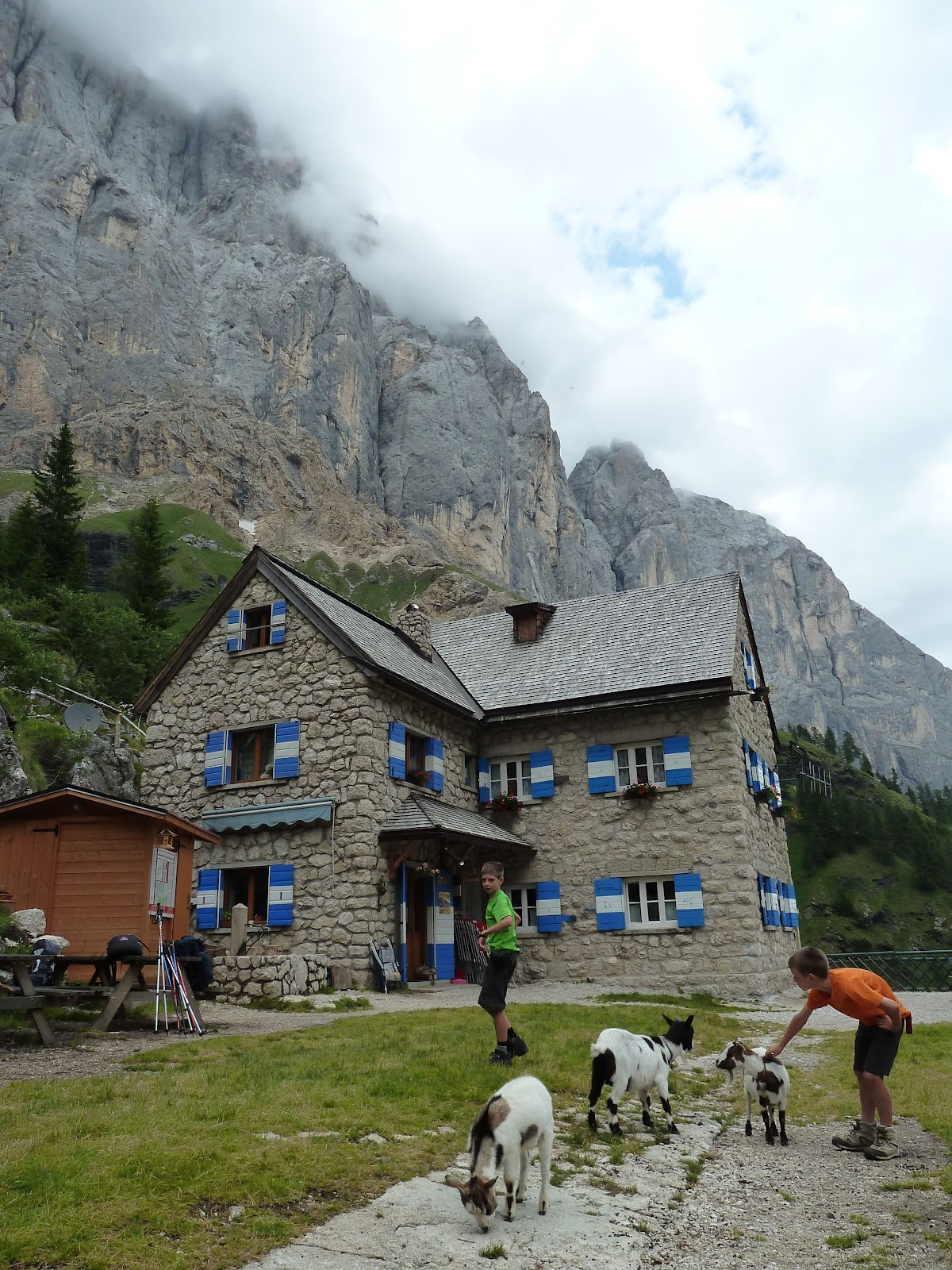
Refuge Falier

Bags everywhere, the hut’s full of excited Italian Alpine Club kids, might not be great for making an alpine start, Wil draws the short straw and has to endure my snoring as well. 4.30 sees us munching down stale hut rolls and jam, will anyone notice if we pinch another? 5 o’clock, bet those guys are going for the same route, we set a good pace and at 6 o’clock start up Don Quixote, 750m of classic grade VI on the Marmolada south face. We make a head start over several other teams, moving together for the first few pitches, only a few slowdowns for route finding uncertainties.

Looking down on Don Quixote

“Be careful dropping rocks”, Wil says as we move steadily, pressured by the Italian guide following behind. Nevertheless, I place the camelot he hands me and clip in his rope as I move off the belay, thinking his client at least might appreciate a good belay. Later on he demonstrates super dexterity, somehow not dropping his phone while simultaneously chatting to pals “I’m on the Marmolada” and belaying, lighting up to ease the stress of poor mobile signal.


Half way scree ledges

Pitch 5 the climbing gets more challenging and we start pitching, and by mid morning we’ve reached scree ledges halfway up. We gobble down crumbly Italian pastry slices, which have somehow survived so far, while scrabbling to untangle a jumble of rope and keep our lead. Later on Wil learns that jacket pockets offer much less confectionery protection.


Wil on upper pitches

We keep our lead and start the more technical upper pitches. Awsome rock covered with pockets and water runnels, mostly around grade V but at 3000 metres it feels hard compared to the climbing earlier in the week. Taking the crux VI pitch, inadvertently following the slightly harder direct variation, I’m thankful for the fixed gear, tenuous smearing on featureless slabs for feet, pulling on insecure finger jams and strenuous laybacks. Reaching the belay, ecstatic on making it, Wil follows and leads through. Only grade V but after the crux it feels hard to me, we both just want the top now.

Sam on upper pitches


Atmospheric swirling mists make fingers numb and wooden, hot aches taking hold, but intermittent clearings to brilliant sunshine thankfully give warm relief. The last pitches seem to take forever, but actually not too long in real time, and at 2.30 we make the summit. Shattered, but psyched to be here, this feels like an achievement, the hardest alpine day either of us has experienced, proud to have made it.


Made it!


Time still to make the cable car down, summit shots then a couple of abseils down the north side onto the glacier. Wil goes first and unfortunately misses the second abseil, clinging nervously to uninspiring pitons and leaving me to re thread some marginally better gear. Typically the rope tangles, but eventually we reach the glacier and wade up soggy snow, with freezing wet trainers tumble into the top station. Back down, we stretch out over wooden benches and sip coffee, satisfied and happy to chill out, no more challenges waiting for now. Two guys approach and ask how it was, they’re going for the route tomorrow, we chat, feeling important that anyone’s interested.

Bavarian beer tastes good as we squander left over euros, and after snoozing uncomfortably in the car we wake up aching, looking forward to home. We reach Birmingham before hitting queues for passport control, mercifully tame this time, and chat to two guys with climbing packs.

Home now, excited to tell my stories and reminisce over experiences. Summer 2013, the Comici route on Cima Grande?


Looking up at the Marmolada


More photos from the trip: 
https://plus.google.com/photos/103929906942237290345/albums/5764669851753013153?authkey=CLGf2ev1q9OLEg